By Kate Lockyer
In New Farm: Another 50 Stories, local historian Gerard Benjamin has once again captured the charm of the suburb and surrounds with his deftly-told recounts of days gone by, and their contemporary connections.
Within these pages the reader will find all sorts of fascinating types, including influential pastoralists, plucky midwives, trailblazing female journalists and aviators, and even temperant Rechabites, not to mention larger-than-life characters like the “derring-do” doctor and mysterious New York WWII soldier known as “Moiphy”.
While part of the delight in the book is drawing connections with already familiar names, places and stories, equal delight can be found in finding ideas and occupations never heard of before, so close to home.
Professions now somewhat removed from modern Brisbane will pique a reader’s interest, including stevedores, angle-iron smiths and wool-lumpers, not to mention the quaint phrase of “licensed victuallers” which described the proprietors of the Dunmore Arms Hotel.
Those familiar with the area’s street names – or even suburb names – will find many familiar appellations within, like the story behind local sawmill company secretary Joseph Beeston.
Mr Benjamin’s book also recounts the tale of the ship Fortitude, which docked in Brisbane in 1849 carrying Protestant immigrants and later gave its name to Fortitude Valley.
Some businesses detailed are long since gone, but hints remain in the lettering on a building or in old photographs.
One we may be glad to have farewelled was Wilcox & Mofflin Ltd on the corner of Longland and Doggett St, which must have had a strong scent as a hide and skins store seeking “Opossum and other Marsupial skins”.
Many touching stories of the men and women who served in WWI also abound, including the history behind the names on the New Farm Bowls Club honour roll.
Following the recent controversy over the Teneriffe Banks project on Skyring Terrace, it was interesting to note that over 100 years ago, there was similarly controversy over a site nearby.
Vacuum Oil Co’s plant was opposed in 1908 by the nearby gasworks due to a risk of flooding and therefore a risk of kerosene and spirits being carried downstream and mixing with the gas – a flammable combination.
Like today, the development proceeded despite objections.
The book also provides evocative descriptions of how the wealthy lived in style, such as Blenhelm House with its “12 rooms, surrounding eight-foot verandahs, Kauri Pine interiors and marble mantelpieces, let alone the extensive list of furnishings headed by a Pohlmann & Sons upright grand piano in walnut”.
Historical writing sometimes means working with scant sources of information, but these chapters are made so easily readable thanks to Mr Benjamin’s ability to find colour in the smallest scrap of detail – whether it is the instance of a missing horse or fireballs in a storm.
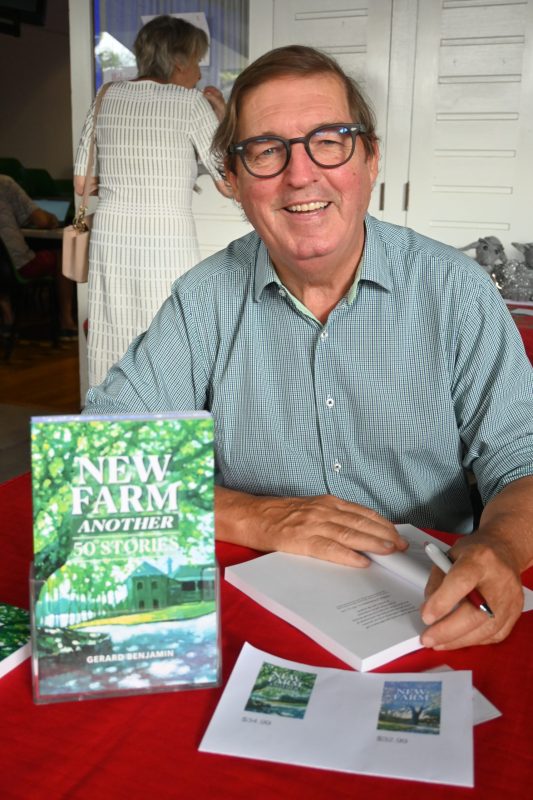
Photo caption: This book is the sequel to Gerard Benjamin’s original New Farm: 50 Stories, both with front cover illustrations by local painter David Hinchliffe


